Science
Ohm's law explained simply
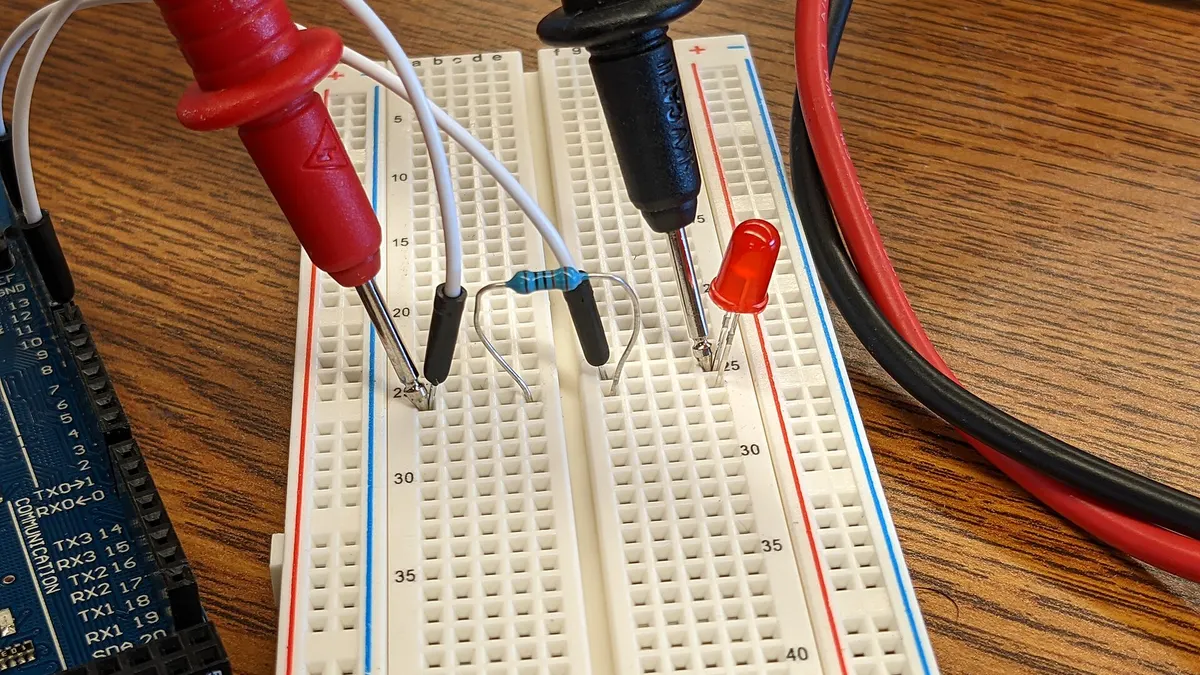
Every electronics project, from a torch to a games console, depends on one simple rule discovered by Georg Ohm in 1827: the current through a conductor is proportional to the voltage across it.
The water-pipe picture
- Voltage (V) is like water pressure: the push.
- Current (I) is like the flow of water: how much passes each second. It is measured in amps (A).
- Resistance (R) is like a narrow section of pipe that limits the flow. It is measured in ohms (Ω).
More pressure, more flow. Narrower pipe, less flow. Written as an equation: V = I x R.
Worked examples
- A 12 V supply drives a 4 Ω heater. Find the current. I = V ÷ R = 12 ÷ 4 = 3 A.
- A 0.5 A current flows through a 220 Ω resistor. Find the voltage across it. V = 0.5 x 220 = 110 V.
- A bulb draws 0.25 A from a 6 V battery. What is its resistance? R = 6 ÷ 0.25 = 24 Ω.
Power: how hot it gets
Power, measured in watts, is the rate energy is used: P = V x I. In example 1, the heater uses 12 x 3 = 36 W. Resistors have a power rating, and going over it makes them hot enough to fail, which is why the calculator always reports power too.
Resistors in series and parallel
Series (one after another): add them. 100 Ω and 330 Ω make 430 Ω. The same current flows through both.
Parallel (side by side): the current has more than one path, so the total resistance drops. For two resistors, R = (R₁ x R₂) ÷ (R₁ + R₂). Two 100 Ω resistors in parallel give 50 Ω.
A real project: choosing an LED resistor
A red LED needs about 2 V and 20 mA (0.02 A). On a 9 V battery, the resistor must drop the other 7 V. R = 7 ÷ 0.02 = 350 Ω. Resistors come in standard values, so pick the next one up, 390 Ω, which keeps the current safely a little below 20 mA.
Safety first
School circuits use low voltages for a reason. Never experiment with mains electricity, and always disconnect the battery before changing components on a breadboard.
More study notes
 Algebra · 6 minHow to solve linear equationsLearn to solve linear equations with one reliable method: expand, collect, isolate and check. Includes brackets, fractions and simultaneous equations.
 Algebra · 5 minScientific notation explainedUnderstand scientific notation with real examples from space and biology. Convert numbers, multiply and divide in powers of ten, and avoid the usual mistakes.
 Data · 6 minStandard deviation for studentsA friendly explanation of standard deviation using class experiments: what spread means, how to calculate it by hand, sample vs population, and how to use it.