Algebra
Scientific notation explained
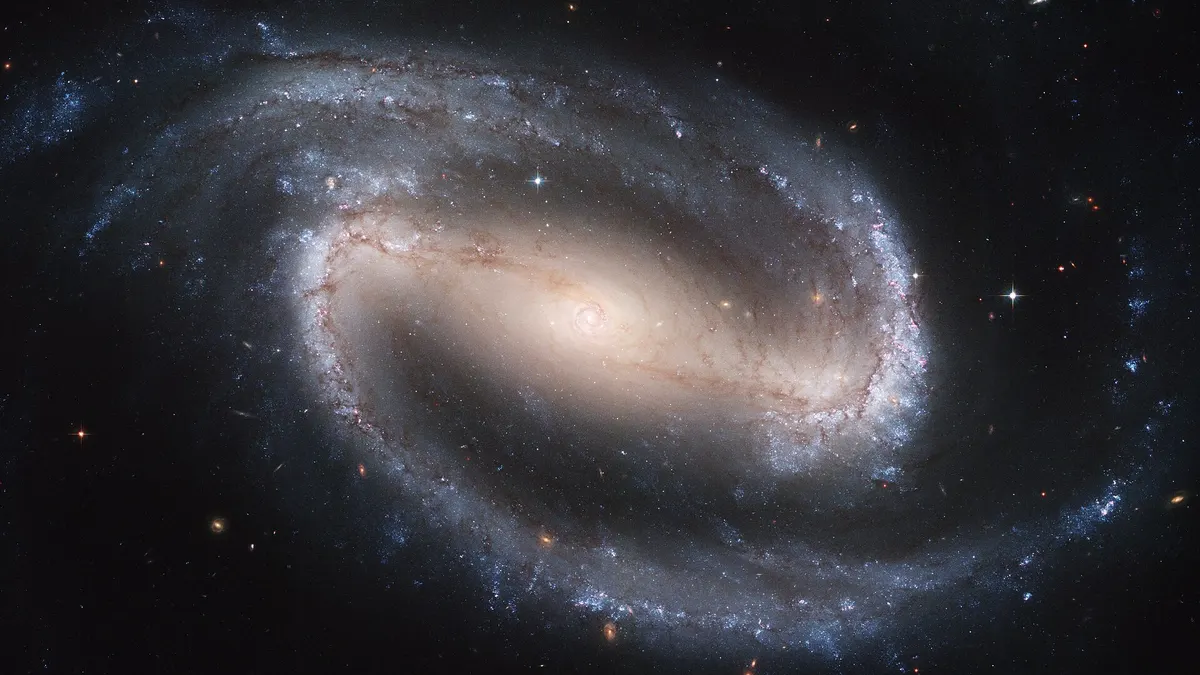
The galaxy in the photo above is about 100,000 light years across, and each light year is roughly 9,460,000,000,000 km. Multiply those and you get a number with more zeros than anyone wants to count. Scientists solved that problem long ago with scientific notation.
The format
A number in scientific notation has two parts: a number from 1 up to (but not including) 10, and a power of ten. 9,460,000,000,000 becomes 9.46 × 10¹². The power tells you how many places the decimal point has moved.
Converting big numbers
Start with 52,000,000. Put the decimal point after the first digit: 5.2. Count how many places it moved to the left: 7. So 52,000,000 = 5.2 × 10⁷.
Converting small numbers
A bacterium might be 0.0000025 m long. Move the point right until one non-zero digit sits in front: 2.5. That took 6 moves to the right, so the power is negative: 2.5 × 10⁻⁶ m. A negative power always means a number smaller than 1.
Multiplying and dividing
This is where scientific notation really pays off. Multiply the front numbers and add the powers; divide the front numbers and subtract the powers.
- (3 × 10⁴) × (2 × 10⁵) = 6 × 10⁹
- (8 × 10⁶) ÷ (4 × 10²) = 2 × 10⁴
- (5 × 10³) × (4 × 10²) = 20 × 10⁵, which must be tidied to 2 × 10⁶
That last one shows the step people forget: if the front number ends up 10 or more, shift it back into range and adjust the power.
Adding and subtracting
You can only add directly when the powers match. To add 3 × 10⁴ and 5 × 10³, rewrite the second as 0.5 × 10⁴, then add: 3.5 × 10⁴.
Reading your calculator
Calculators and spreadsheets usually show scientific notation with an E: 6.02E23 means 6.02 × 10²³. If your answer to a simple question comes out like 3.2E-5, you have not made an error. That is just 0.000032.
Numbers worth knowing
| Thing | Size |
|---|---|
| Speed of light | 3.0 × 10⁸ m/s |
| Earth's mass | 6.0 × 10²⁴ kg |
| Width of a human hair | about 7 × 10⁻⁵ m |
| Charge of an electron | 1.6 × 10⁻¹⁹ C |
More study notes
 Algebra · 6 minHow to solve linear equationsLearn to solve linear equations with one reliable method: expand, collect, isolate and check. Includes brackets, fractions and simultaneous equations.
 Data · 6 minStandard deviation for studentsA friendly explanation of standard deviation using class experiments: what spread means, how to calculate it by hand, sample vs population, and how to use it.
 Science · 5 minSpeed, distance and time word problemsMaster speed, distance and time word problems with the formula triangle, unit conversions, average speed traps and six worked examples with answers.